Every so often, someone lands on my site specifically because they're wondering this: is evolution still happening?
Depends what you mean, really. We hear often how viruses and bacteria mutate, seeming to generate new ways to attack us all the time. Take bacteria (which are more readily classed as living entities). They proliferate by dividing (binary fission), and their generations are far, far more rapid than ours. Greater population, fast breeding, more scope for genetic change that is more visible to us.
Yet broadly we conceive evolution in terms of how we humans got to where we are today. And that's the product of hundreds of millions of years (and elaborated in my earlier discussion here). Saying that is one thing, but understanding it is far more difficult, because our human scale takes its measure in one lifetime. At best, we extend ourselves to the whole of human history, which is only a few thousand years - a tiny speck on the scale of hundreds of millions. I call this issue deanthropocentrism: the effort required to conceptually escape our human framework, and understand processes that work on vastly different scales. To do this more than superficially is not nearly as easy as it sounds.
So some of us think, how can this be, does this evolution really make sense? Yes, it does, just not so much in our immediate framework.
Yet the sun is still emitting radiation that occasionally knocks around with DNA in our germ-line cells, producing the odd change. Such changes can add up over time, if beneficial for survival. If a mutation improves the odds of an individual surviving and breeding, that mutation is more likely to survive. In the past, this was "natural selection" - ie, mutation survived where the "whole of environment" (including climate, food resources, food competitors, and predators) fostered it. These days, humans frequently take that role, exercising selectivity over both plant and animal breeds.
How does selectivity work today on humans? Well, we've diluted it substantially. By improving global health, we're over-riding natural selectivity. We're increasing the survival rates of those who have adverse genetic outcomes. For example, cystic fibrosis sufferers once seldom lived far beyond puberty, but survival has now been prolonged past breeding age.
Is that a bad thing?
No, because we are ethical beings, not ones to ride on the whim of random outcomes.
Over time, our technology can improve outcomes, identify potential issues before they happen, find solutions.
And we are now at the point where the environment is a product of us, not vice versa. So what of climate change? Although we can say human adaptions that are better suited to a hotter, more turbulent world are better able to survive, the question is whether those less adaptive are likely to survive to breed. And our global culture no longer fosters selectivity purely on that basis - bar a calamitous breakdown of society.
So these are the issues: whether and how we intervene in 'natural' selectivity. Such intervention can bring human evolution to a halt. The only selectivity for breeding now is societal, and I have seen no indication so far of any specific genetic determinant on those who end up remaining single all their lives (in the sense that they produce no offspring).
In that sense it could be said that humans, for the time being, have induced their own evolutionary pause. However, that might not be such a bad thing: natural selectivity could work in any direction, depending on environment. Bigger (or brighter, or more complex) is not necessarily better for survival, for example - as the dinosaurs found out.
Showing posts with label time. Show all posts
Showing posts with label time. Show all posts
Monday, August 31, 2009


Saturday, January 10, 2009
The big bang was a bounce?
A recent article in New Scientist posited the idea that the big bang was really a bounce.
It details a computer simulation, based on Loop Quantum Theory, that runs time backwards to the big bang, which demonstrates a bounce back to a previous(ly collapsing) universe. This is apparently one up on general relativity, which breaks down at the big bang.
Having only completed undergraduate physics and maths, the article will take some time for me to absorb properly. But there is a certain neatness to the concept of a universe continuously expanding and collapsing. I would imagine that in that case, there would be no state memory retained from the previous incarnation, so all prior information/knowledge (both about and within the prior universe) would be lost. There is sufficient unevenness to the expansion after a big bang that successive universes would not develop identically.
I have previously drawn a depiction of how time could work going backwards to the big bang. It's a conceptualisation, rather than based on hard physics. The above theoretical paradigm would be closer to hard physics, but still just theory at this point.
In the process of conceiving a universe running backwards to the big bang, most people might imaging a large box, with the matter filling a decreasing amount of space in the middle of the box. Fewer would imagine space as being a contracting 'box', with nothing 'outside' it, because it's hard to think of a space without automatically extending one's thoughts beyond the limits. Likewise with time. Is 'what happened before the start of time' a valid construct?
There is no certainty yet, but I think the ultimate solution would have a satisfying neatness and symmetry.
It details a computer simulation, based on Loop Quantum Theory, that runs time backwards to the big bang, which demonstrates a bounce back to a previous(ly collapsing) universe. This is apparently one up on general relativity, which breaks down at the big bang.
Having only completed undergraduate physics and maths, the article will take some time for me to absorb properly. But there is a certain neatness to the concept of a universe continuously expanding and collapsing. I would imagine that in that case, there would be no state memory retained from the previous incarnation, so all prior information/knowledge (both about and within the prior universe) would be lost. There is sufficient unevenness to the expansion after a big bang that successive universes would not develop identically.
I have previously drawn a depiction of how time could work going backwards to the big bang. It's a conceptualisation, rather than based on hard physics. The above theoretical paradigm would be closer to hard physics, but still just theory at this point.
In the process of conceiving a universe running backwards to the big bang, most people might imaging a large box, with the matter filling a decreasing amount of space in the middle of the box. Fewer would imagine space as being a contracting 'box', with nothing 'outside' it, because it's hard to think of a space without automatically extending one's thoughts beyond the limits. Likewise with time. Is 'what happened before the start of time' a valid construct?
There is no certainty yet, but I think the ultimate solution would have a satisfying neatness and symmetry.
Monday, June 02, 2008
Evolution: life on Earth started earlier
I record the following recent news report, which has quite meaningful implications. Some questions on the reportage niggle me, which I will record below, hopefully addressed when I find out more.
Australian scientists have found that life on Earth begain much earlier - and progressed faster - than previously believed.
The scientists, from the newly-inaugerated Centre for Astrobiology at the University of New South Wales (a short walk from here) studied stromatolites in tidal pools in Shark Bay in Western Australia. Stromatolites are traces left by bacteria life (as opposed to fossilised remnants of organisms), composed of calcium carbonate, the same substance shells are made of.
 Shark Bay stromatolites
Earth was formed 4.54 billion years ago; stromatolites dating from 2.5 billion years had previously been found - also from Western Australia.
The Shark Bay specimens are very recent, dating from 10,000 years ago up to the present - uncommon, because stromatolite formations usually date from carbon-dioxide-rich times, prior to the buildup of a relatively oxygen-rich atmosphere from about 2.4 billion years ago.
The study found that the Shark Bay microbe colonies - little different from the 3.5 billion year old samples - consist of hundreds of different species, which perform a range of different tasks that each contribute to the survival of the overall ecosystem. This mutual dependency, according to Dr Brett Neilan, demonstrates that Earth was "already teeming with diverse microbial life", and thus life was evolving at least "many ten of millions of years earlier" than the 3.5 billion year mark.
The announcement was timed to coincide with the launch of the new Centre. How significant is it? On the one hand, "many tens of millions of years" would not seem to add many percentage points to the origin of life. However, it could be said that every bit counts. As I recorded in February, a recent study calculated that there was only about a billion years' worth of viable life left in the planet - before the sun expands to the point Earth becomes uninhabitable.
The chief issue is how contingent - and thus unlikely - the appearance of life is. The further back the origin is pushed, the less contingent life is on chance conditions: the more inevitable it becomes if the circumstances are right - that is (as far as we know it), a star of our sun's size, plus planetary objects of the right size in the right range of distance from the star.
(I have no specific need to tear down idols - they're already down as far as I'm concerned, and life is already here. But it speaks to an increase in the odds of encountering signs of life within a detectable distance from our sparsely populated arm of the galaxy.)
The scientists reporting this study do stress the similarity of the stromatolite formations to those in WA's Pilbara that were dated to 2.5 billion. My first inclination would be to wonder if that necessarily means the Shark Bay colonies are no more evolved than those in the Pilbara. They're the experts, so I'd have to take their word for it. I'd like to know more about those issues, though.
Australian scientists have found that life on Earth begain much earlier - and progressed faster - than previously believed.
The scientists, from the newly-inaugerated Centre for Astrobiology at the University of New South Wales (a short walk from here) studied stromatolites in tidal pools in Shark Bay in Western Australia. Stromatolites are traces left by bacteria life (as opposed to fossilised remnants of organisms), composed of calcium carbonate, the same substance shells are made of.
 Shark Bay stromatolites
Earth was formed 4.54 billion years ago; stromatolites dating from 2.5 billion years had previously been found - also from Western Australia.
The Shark Bay specimens are very recent, dating from 10,000 years ago up to the present - uncommon, because stromatolite formations usually date from carbon-dioxide-rich times, prior to the buildup of a relatively oxygen-rich atmosphere from about 2.4 billion years ago.
The study found that the Shark Bay microbe colonies - little different from the 3.5 billion year old samples - consist of hundreds of different species, which perform a range of different tasks that each contribute to the survival of the overall ecosystem. This mutual dependency, according to Dr Brett Neilan, demonstrates that Earth was "already teeming with diverse microbial life", and thus life was evolving at least "many ten of millions of years earlier" than the 3.5 billion year mark.
The announcement was timed to coincide with the launch of the new Centre. How significant is it? On the one hand, "many tens of millions of years" would not seem to add many percentage points to the origin of life. However, it could be said that every bit counts. As I recorded in February, a recent study calculated that there was only about a billion years' worth of viable life left in the planet - before the sun expands to the point Earth becomes uninhabitable.
The chief issue is how contingent - and thus unlikely - the appearance of life is. The further back the origin is pushed, the less contingent life is on chance conditions: the more inevitable it becomes if the circumstances are right - that is (as far as we know it), a star of our sun's size, plus planetary objects of the right size in the right range of distance from the star.
(I have no specific need to tear down idols - they're already down as far as I'm concerned, and life is already here. But it speaks to an increase in the odds of encountering signs of life within a detectable distance from our sparsely populated arm of the galaxy.)
The scientists reporting this study do stress the similarity of the stromatolite formations to those in WA's Pilbara that were dated to 2.5 billion. My first inclination would be to wonder if that necessarily means the Shark Bay colonies are no more evolved than those in the Pilbara. They're the experts, so I'd have to take their word for it. I'd like to know more about those issues, though.
Sunday, February 24, 2008
End of life: sooner than you think
Stephen Jay Gould was fond of emphasising the contingent nature of life - and in particular the emergence of humans.
The earth is 4.5 billion years old, and it had been estimated that we are at about the halfway point in the planet's existence.
As we saw previously, life emerged about 3.5 billion years ago, about as soon as it theoretically could. However, it was not until around 540mya that complex multicellular animal life (as we know it) appeared.
A new paper by a University of Sussex astronomer, Dr Robert Smith, actually calculates that the Earth has another 7.6 billion years to go. But now for the bad news. According to Smith's team, the slow expansion of the sun will cause temperatures to rise well before that: "the oceans will boil dry and the water vapour will escape into space. In a billion years from now the Earth will be a very hot, dry and uninhabitable ball."
So, we actually have less than a billion years left on this planet. We're here near the end of its cycle, not the middle.
Of course, a billion years is a long time for us to come up with other means of survival. If we don't kill the planet earlier.
But the point is, in the great contingent nature of our planet's history, there's effectively only a small window of time in which such complex life as ours could have developed.
Lucky our war against prokaryotes (see previous entry) has been balanced as much in our favour as this. But are we already starting to tip the balance back the wrong way?
The earth is 4.5 billion years old, and it had been estimated that we are at about the halfway point in the planet's existence.
As we saw previously, life emerged about 3.5 billion years ago, about as soon as it theoretically could. However, it was not until around 540mya that complex multicellular animal life (as we know it) appeared.
A new paper by a University of Sussex astronomer, Dr Robert Smith, actually calculates that the Earth has another 7.6 billion years to go. But now for the bad news. According to Smith's team, the slow expansion of the sun will cause temperatures to rise well before that: "the oceans will boil dry and the water vapour will escape into space. In a billion years from now the Earth will be a very hot, dry and uninhabitable ball."
So, we actually have less than a billion years left on this planet. We're here near the end of its cycle, not the middle.
Of course, a billion years is a long time for us to come up with other means of survival. If we don't kill the planet earlier.
But the point is, in the great contingent nature of our planet's history, there's effectively only a small window of time in which such complex life as ours could have developed.
Lucky our war against prokaryotes (see previous entry) has been balanced as much in our favour as this. But are we already starting to tip the balance back the wrong way?
Tuesday, July 03, 2007
Human evolution in perspective
Evolution keeps fascinating me. The earth is 4.5 billion years old, life on earth began 3.8 billion years ago, and the homo genus is only 2 million years old. The species Homo Sapiens is only about 250,000 years old, but only left Africa about 80 – 100,000 years ago. (Take a walk through Wikipedia articles on Homo Sapiens, human evolution, geologic time, and the single origin hypothesis.)
(There’s also the proposition that there was a human bottleneck about 70,000 years ago, which reduced the population of breeding pairs to between 1,000 and 10,000 – see the Homo Sapiens article – which is postulated to be due to the mammoth Toba volcanic eruption.)
(There’s also the proposition that there was a human bottleneck about 70,000 years ago, which reduced the population of breeding pairs to between 1,000 and 10,000 – see the Homo Sapiens article – which is postulated to be due to the mammoth Toba volcanic eruption.)
The serious point here is that these changes are dramatically exponential, rather than linear.
A recent article on continuing evolution mentions a few other interesting facts, inter alia. For instance, that lactose tolerance emerged among European cattle herders only about 5,000 years ago.
It also mentions a genomic survey five years ago that found people were clustered on the basis of small DNA changes into five groups, roughly corresponding to the continents: Africans, Australian Aborigines, East Asians, American Indians, and Caucasians. That latter group includes everyone from Europe to India, including the Middle East.
I would add more recent changes that have a lasting effect on the population, such as the constant plagues in Europe in the middle ages, which had a dramatic impact on the population, and undoubtedly divided the genetic pool.
Ye The domination of dinosaurs prevented mammal expansion beyond the size of a shrew, but a chance meteor impact cleared away the larger animals that couldn't burrow or hide, and left the planet empty enough for the speciation of those who could. And there's the Homo genus Neanderthal, which died out despite a larger brain capacity than us.
Species domination is not necessarily about being the "best and brightest": it’s about what survives the particular environments of the time.
...which doesn't bode well for us, if we're now powerful enough to destroy our own evolutionary niche, our environment.

Wednesday, May 09, 2007
Ediacarans, the Cambrian explosion, and the evolution saga
The Cambrian explosion is good illustration that however much you think you know, you don't know enough.
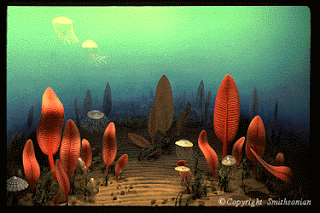 Ediacarans
People who are skeptical about evolution (generally, bible-belt americans) don't know what the real gaps are in our understanding - they're caught up in the perception of the nonsense of it all. I think the biggest barrier to to a ready acceptance is simply time. We just don't have a real framework for understanding the scales involved.
Evolutionary changes take place over millions of years - yet we're still into a few thousand of recorded history.
There's little trace of civilisation (the neolithic revolution came with the advent of agriculture) at all beyond the last ice age - which is only 10,000-odd years ago.
Homo sapiens only emerged about 200,000 years ago.
Tools from H Sapiens' ancestor, Homo Erectus, date back up to about 2,400,000 years.
The earliest primates (from which the Homo genus emerged) were 60,000,000 years ago.
Dinosaurs lived from 230 million to 65 million years ago - lost to a catastrophic extinction event at the end of the cretaceous period.
The Cambrian explosion started about 540 million years ago. It was a sudden increase in diversification and complexity of organisms, marking the first emergence of multicellular animals, albeit nothing remotely familar to us now.
Any other life form is referred to as precambrian. Many of those life forms were as alien as they were primitive, illustrating a great variety of evolutionary dead ends.
A recent New Scientist magazine had an article on the precambrian Ediacarans, organisms that lived from about 575 million years ago, up to the Cambrian explosion. They resembled animals in some ways and plants in others, and lived on the sea floor, feeding off organic matter. They looked something between ferns and seaweed, but in a wide variety of shapes.
In 2004, it was discovered their composition was Fractal! - made of fronds composed of smaller, identical fronds, which were in turn composed of smaller, identical fronds, and so on. They were all like that, and they dominated the planet for 30 million years.
Yet for three billion years before that, life was restricted to the microbial level. The theory goes that Ediacarans emerged from the aftermath of the last great ice age of the precambrian era. Much of the Earth was frozen, and when the ice melted, it freed up a soup of organic matter, which fed and fostered the Ediacarans (also helped along by high oxygen levels).
Competing theories on these creatures held that they were either an evolutionary dead-end, or the "long fuse" that lit the Cambrian explosion. The article suggested they were both.
Why the Cambrian explosion in the first place? We're still finding out more all the time, but to my mind, it's simply another expression of the mechanism of evolution.
Evolution is a process, not a theory, and it's a long, long story. It's entirely mechanistic, but with such a lot of events, characters, mystery and plot turns that it can keep us eternally fascinated.
Friday, September 15, 2006
Tech: Unified theory is all very well, but
6.36pm
In quantum mechanics, a particle is in several places at once, yet only exists in one of those places when you look at it.
Obviously, it exists across all space-times in that point. That is why, whenever you view a particle it only appears at one point, because at all other of those points, of that inhabited space, it is in all other space-times in the dimensional universe.
This may or may not speak to concepts of travel or alternative universes. I wouldn't stick my head out.
In quantum mechanics, a particle is in several places at once, yet only exists in one of those places when you look at it.
Obviously, it exists across all space-times in that point. That is why, whenever you view a particle it only appears at one point, because at all other of those points, of that inhabited space, it is in all other space-times in the dimensional universe.
This may or may not speak to concepts of travel or alternative universes. I wouldn't stick my head out.
Friday, March 24, 2006
World: The age of everything
The universe: 13,700 million years
Earliest stars: 13,300 million
Sun: 4,700 m
earth: 4,500 m
Life on earth: 600 m
Earliest dinosaurs: 200 m
Current life forms: 10 m
Homo sapiens: 0.2 m (200,000 years)
Known history: 10,000
I thought it would be useful to give a bit of perspective for everything. Yes, we all know human history is crammed into the last second of the evolutionary clock. But to collate where everything else fitted in, I had to use a variety of sources.
Some people like to say there's only 5,000 million years of fuel left in the sun. But this is pretty irrelevant; it dwarves human history, and the earth isn't even that old. Stephen Hawking also felt so moved to pointlessly mention this (A Brief History Of Time).
I once thought it was a shame we're on an outer arm of our galaxy the Milky Way, because if we were closer to the densely packed centre, we'd be closer to a lot of other life forms. But then I read up on quasars. These seem to be galactic centres that collapsed in on themselves, ie if you're at the centre, you'll get sucked into a mammoth black hole. No thanks. Even given the time scales for this to happen, it sounds dodgy.
To get an idea of our place in the universe physically, I strongly recommend Monty Python's The Galaxy Song (analysed here). Lots of useful information therein.
Earliest stars: 13,300 million
Sun: 4,700 m
earth: 4,500 m
Life on earth: 600 m
Earliest dinosaurs: 200 m
Current life forms: 10 m
Homo sapiens: 0.2 m (200,000 years)
Known history: 10,000
I thought it would be useful to give a bit of perspective for everything. Yes, we all know human history is crammed into the last second of the evolutionary clock. But to collate where everything else fitted in, I had to use a variety of sources.
Some people like to say there's only 5,000 million years of fuel left in the sun. But this is pretty irrelevant; it dwarves human history, and the earth isn't even that old. Stephen Hawking also felt so moved to pointlessly mention this (A Brief History Of Time).
I once thought it was a shame we're on an outer arm of our galaxy the Milky Way, because if we were closer to the densely packed centre, we'd be closer to a lot of other life forms. But then I read up on quasars. These seem to be galactic centres that collapsed in on themselves, ie if you're at the centre, you'll get sucked into a mammoth black hole. No thanks. Even given the time scales for this to happen, it sounds dodgy.
To get an idea of our place in the universe physically, I strongly recommend Monty Python's The Galaxy Song (analysed here). Lots of useful information therein.
Thursday, March 02, 2006
World: How time really works
Time is like the graph of y = 1/x.
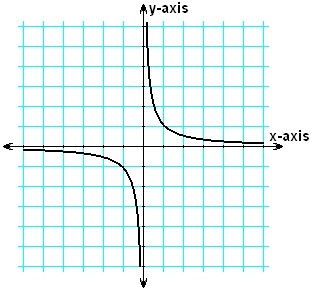
* Thanks to Wikibooks for the chart.
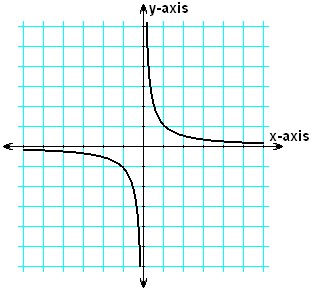
This is an attempt to explain the big bang. It's a simple model that can help understand what happens closer to the event itself.
I will call the graph 'experience'. We experience time and... something else. Let's call that something ujnf (pronounced 'ujnif'). Time=x; ujnf=y.
Of course, experience only moves in one direction (as far we are aware). We're in the positive quadrant, a fair bit down the time track where x is a fairly large number and the line appears to us as quite flat. We really only know experience as time, with no discernable aspect in the y, or ujnf, dimension.
The origin, where x=0 and y=0, is the big bang - ie the beginning of the universe. As you can see, we can never actually get there. As we look backwards along the experience line, the secondary dimension, ujnf, actually moves a little bit, and as we get closer to the big bang, the time dimension slows right down. Eventually experience is moving nearly entirely in the ujnf dimension.
With this model, time slows down moving closer to the big bang, but you never actually get there. I believe that squares with some other views on that end of the universe - and it answers the question: what happened before the big bang? Answer: you can never actually get there (per below, it would be like trying to cross to a different universe). Close to the event, time slows down - but experience moving in a different direction. Not that this could be experienced, just conceptualised.
This means:
a) if we could travel backwards in time - or rather, experience - we'd never actually get to the big bang, because although experience would continue as ujnf, the time component would slow down until it effectively stops.
b) the big bang is a singularity, and like all singularities (black holes in particular) we can never actually experience it. (In black holes, time also slows down, but gravity would rip us to pieces, probably before we started experiencing ujnf.)
Questions:
1) What is ujnf?
2) Are we really too far down the track to experience ujnf at all?
3) Would we have the senses to feel ujnf?
4) What is that negative part of the graph - negative time and negative ujnf? Obviously it's before the start of the universe, but how do we conceptualise it?
5) In the conceptual model, what does it mean if we move the experience line closer to the origin - eg y=1/x squared?
6) As I said, it's only a simple model. For example, why should there be only two dimensions?
There are several ways in which this can tie in with physicist Leonard Susskind's conceptualisation of multiple universes. Most of those methods - except 5) & 6) above - would involve crossovers from one universe to another. I doubt that would be possible, so let's just stick to crossing to another universe via (impossible) movement in the direction of y=x. But his is more in the realm of science fiction, as far as we know today.
I came up with this model some years back. Are there any theoretical developments that either mimic or negate this? Your comments please.
(I reserve the right to refine this discussion as time goes by. If not ujnf.)
* Thanks to Wikibooks for the chart.
Subscribe to:
Posts (Atom)